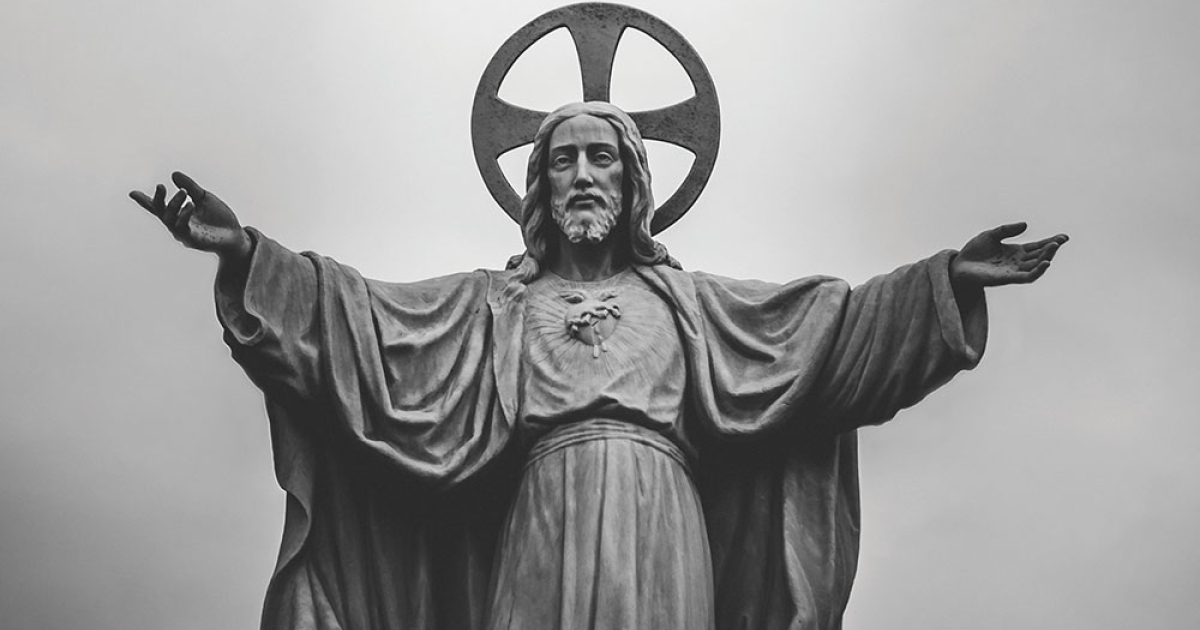
The halo (from the Greek *halos*, meaning ring or disc) is a natural phenomenon appearing as a ring around the sun or moon, caused by refracted or reflected light. Similarly, the corona (Latin for wreath) surrounding the sun during a total eclipse shares a comparable appearance. Any of these halo forms may also be called a nimbus (Latin for cloud). Some authorities suggest that terms such as nimbus, aura, aureole, glory, or gloriole (Latin for a small glory) can be used interchangeably.
Contrary to popular belief, the halo was not a Christian artistic invention. The depiction of a burst of light behind revered individuals and deities began in the East at least two centuries before Christ. This practice eventually reached Rome, where rays of glory were drawn emanating from Helios, the god of the sun.
Due to the association with paganism, Christian artists were initially slow to adopt halos. However, the concept of martyrs crowned in glory is rooted in Christian scripture, notably the promise found in Revelation: “Remain faithful until death, and I will give you the crown of life” (Revelation 2:10). Rays of light emanating from the figure of Jesus began to be depicted in Rome by the mid-third century. Initially, signs of glory were reserved exclusively for Him until the fifth century, when halos began to be used to indicate sainted individuals.
Over time, special radiances evolved into various shapes depending on the holiness or state of eminence of the subject. Christian iconographers placed halos around the heads of Jesus, God the Father, the Holy Spirit dove, the Virgin Mary, angels, and all recognized saints.
### The Nimbus
The nimbus can take several forms:
– The *ring*: a simple circle
– The *disk*: a solid circle
– The *corona*: a luminous circle
In art, these forms appear behind and surrounding the heads of the blessed. They might also be depicted horizontally, hovering over holy heads, or tilted over the crown of the head, reflecting the perspective of the sanctified person portrayed.
### The Mandorla
The mandorla (Italian for almond) first appeared in the fifth century as an ovoid shape outlining the entire body of an individual. Also known as the *vesica piscis* (a stylized fish shape), the mandorla came to symbolize the divinity of the Persons of the Holy Trinity.
It is considered an artistic distortion to depict the Virgin Mary or another saint within a mandorla unless they are holding the Christ Child or are otherwise accompanied by the divine God the Son. The use of the mandorla declined in the 15th century. According to *Britannica*: “The mandorla became incongruous in a naturalistic context.” The aura or glory gradually replaced the mandorla in religious art.
### The Aureole
The aureole (Latin for golden, diminutive of *aureus*) is a radiant light artistically surrounding the head or emanating from the body of a sacred personage. The *gloriole*, meaning “a small glory” (likely a blend of *gloria* and *aureole*), usually refers to a crown of glory.
### The Triangular Halo
The triangular halo implies the doctrine of the Holy Trinity—one God in three Divine Persons. It is most often depicted behind the head of God the Father. While it may occasionally be used for God the Son and the Holy Spirit, it is rare, since each Divine Person is fully God.
This halo is never used to adorn any mortal, no matter how holy.
### The Tri-Radiant or Cruciform Halo
The tri-radiant, or cruciform, halo is an ancient symbol commonly seen within a disk behind the head of Jesus Christ. The three bars or rays symbolize his divinity—some commentators suggest the bars represent the cross, with a fourth bar hidden behind Christ’s head and neck.
Because all three Persons of the Holy Trinity are equal in dignity, the tri-radiant halo may also be used for the Father and the Holy Spirit.
### The 12-Starred Crown
The halo of 12 stars, often depicted as a crown of 12 stars, is reserved for Mary as the Woman of the Apocalypse:
“A great sign appeared in the sky, a woman clothed with the sun, with the moon under her feet, and on her head a crown of twelve stars” (Revelation 12:1).
Pope Benedict XVI explained:
“This sign symbolizes the 12 tribes of Israel and means that the Virgin Mary is at the center of the People of God, of the entire communion of saints. And thus this image of the crown of 12 stars ushers us into the second great interpretation of the heavenly portent of the ‘woman clothed with the sun.’”
This image also symbolizes Mary as queen of the apostles.
### The Hexagon
The hexagonal halo is seen in late Middle Ages art behind the heads of figures representing the virtues. More commonly, it denotes holy personages of the Old Testament, including those who lived during the New Testament era but before the Resurrection, such as Saints Joachim and Anne, or even Joseph.
### The Square
The square halo had a brief period of use. Unlike other halos, it does not imply sanctity but rather designates a person of high social station or a patron of the artist who was alive when the artwork was created.
### The Scroll
Rarely seen, this halo takes the form of a piece of parchment scrolling behind a person’s head, indicating the addition of his or her name to the canon of saints. This depiction is the origin of the word *canonization*.
—
Through living faith in our Lord and following the example of our holy forebears, let us walk in good works (see Ephesians 2:10) so that we may all receive the halos God has prepared for us.
https://themiscellany.org/halos-many-signs-sanctity
About the Author